A free guide from Excell Cleaning Services
The Venue Care Standard
A short, practical guide to caring for heritage and complex venues: the surfaces that make your building photographed, the rooms the public never sees, and how to specify cleaning that protects both. Written by the team that has cleaned London's theatreland since 1994.
This guide sets out general good practice. Every building is different: for a specific surface, follow your conservator's or surveyor's advice first, and agree the method in writing before work starts.
1. Gilt & ornate plasterwork
Gilded surfaces and decorative plaster are the most unforgiving materials in any historic venue. Water lifts gilding; abrasives erase it; even well-meant polish can dissolve a century of patina in an afternoon. The standard is simple: dry methods only, tested first, documented always. Soft natural-bristle brushes and low-suction vacuums with gauze-screened nozzles remove dust without contact pressure. Nothing wet, nothing chemical, nothing improvised. If a mark won't lift dry, the decision to escalate belongs to a conservator, not a cleaner, and a good contractor will tell you that for free.
Specify: dry dusting cycles by level (reachable, ladder, high-level), an annual high-level programme on dark days or closed weeks, and a written ban on liquids and proprietary polishes anywhere near gilt.
2. Velvet, drapes & upholstery
A thousand seats take a thousand sittings a night, and velvet shows everything: crushing, grease, dust bloom in the pile. Routine care is gentle and frequent rather than aggressive and rare: vacuuming with an upholstery head along the pile, prompt dry response to spills, and periodic low-moisture extraction in closed periods, never saturation, which shrinks fabric and rusts fixings. Drapes and tabs collect dust at the hems and headers; they need scheduled attention, not just an annual glance.
Specify: per-performance seat checks, weekly pile vacuuming by section rotation, low-moisture upholstery cleans once or twice a year, and an agreed spill protocol your front-of-house team can trigger at the interval.
3. Marble, terrazzo, stone & brass
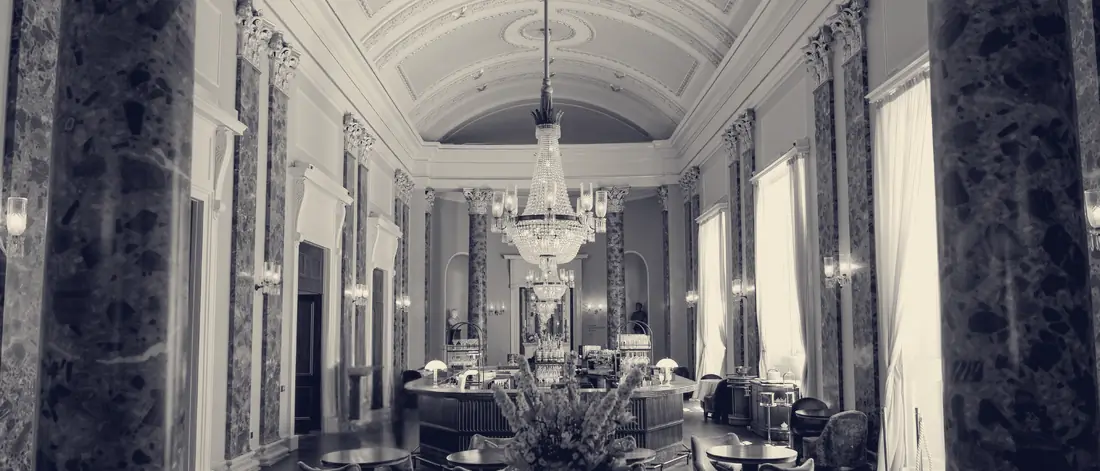
Hard surfaces take the hardest traffic: every guest crosses the same six metres of foyer. The enemy is grit, which acts as sandpaper underfoot, so the foundation is humble: entrance matting deep enough to strip soles, and dust-mopping at a frequency that matches footfall. Washing is neutral-pH only; acidic or alkaline products etch stone and strip sealers. Brass and bronze divide into lacquered (clean only, never polish, polish destroys lacquer) and unlacquered (scheduled hand-polishing). Knowing which is which belongs in the specification, not in a cleaner's guess.
Specify: matting maintenance, daily dust-mop plus neutral wash cycles, a quarterly or annual burnish/restoration cycle for stone, and a metal schedule that records what is lacquered.
4. The turnaround discipline
Complex venues live and die by turnarounds: matinee to evening, seating to seating, daytime visitors to evening event. A turnaround plan is a running order, not a rota: who enters which space when, what "done" looks like, who signs it off and at what time the space hands back. The best venues rehearse it like a scene change. The marker of a specialist contractor is that they ask for your performance or events calendar before they quote, because the calendar is the contract.
Specify: turnaround running orders per space, named handback times, and a supervisor empowered to call short-notice additions when the schedule changes.
5. The rooms the public never sees
Dressing rooms, green rooms, staff areas, plant rooms and stage-door corridors set the standard your team lives with, and they're where corners get cut by contractors who think nobody's looking. They also carry real compliance weight: clear escape routes, clean welfare areas, safe storage of products under COSHH. A venue-grade specification treats backstage with the same written standards as front of house, because your company spends more hours there than your audience spends in the stalls.
Specify: backstage frequencies in writing, COSHH-compliant product storage on site, and welfare areas inspected against the same checklist as public washrooms.
6. Building a specification that protects you
Good venue cleaning runs on five documents: a surface register (what the building is made of, and what each surface needs and forbids), method statements per sensitive surface, a frequency schedule tied to your calendar rather than a generic week, a vetting standard for the people on site, and an inspection regime with named sign-off. Ask any prospective contractor to produce all five for a building like yours. If they can't, they're quoting for offices and hoping.
A short checklist for your next tender
- Does the contractor walk the building before quoting, and do they ask for your events calendar?
- Can they show method statements for gilt, stone and fabric from a comparable venue?
- Who exactly will be on site: vetting level, stability, supervision, and will the same people return?
- How do turnarounds work: running order, handback times, sign-off?
- What happens when something goes wrong: spill at the interval, missed area, damage?
- Are backstage and welfare areas specified in writing, or assumed?
If you'd like a second pair of eyes on any of this, that's precisely what our free site visit is: we walk your venue with you and leave you with a view you can use, whoever you appoint.
Take it with you
Get the PDF
The same guide as a PDF, ready to share with your team or keep beside your next cleaning tender.
Walk your venue with us
A free site visit is a second pair of eyes on your building. We leave you with a view you can use, whoever you appoint.